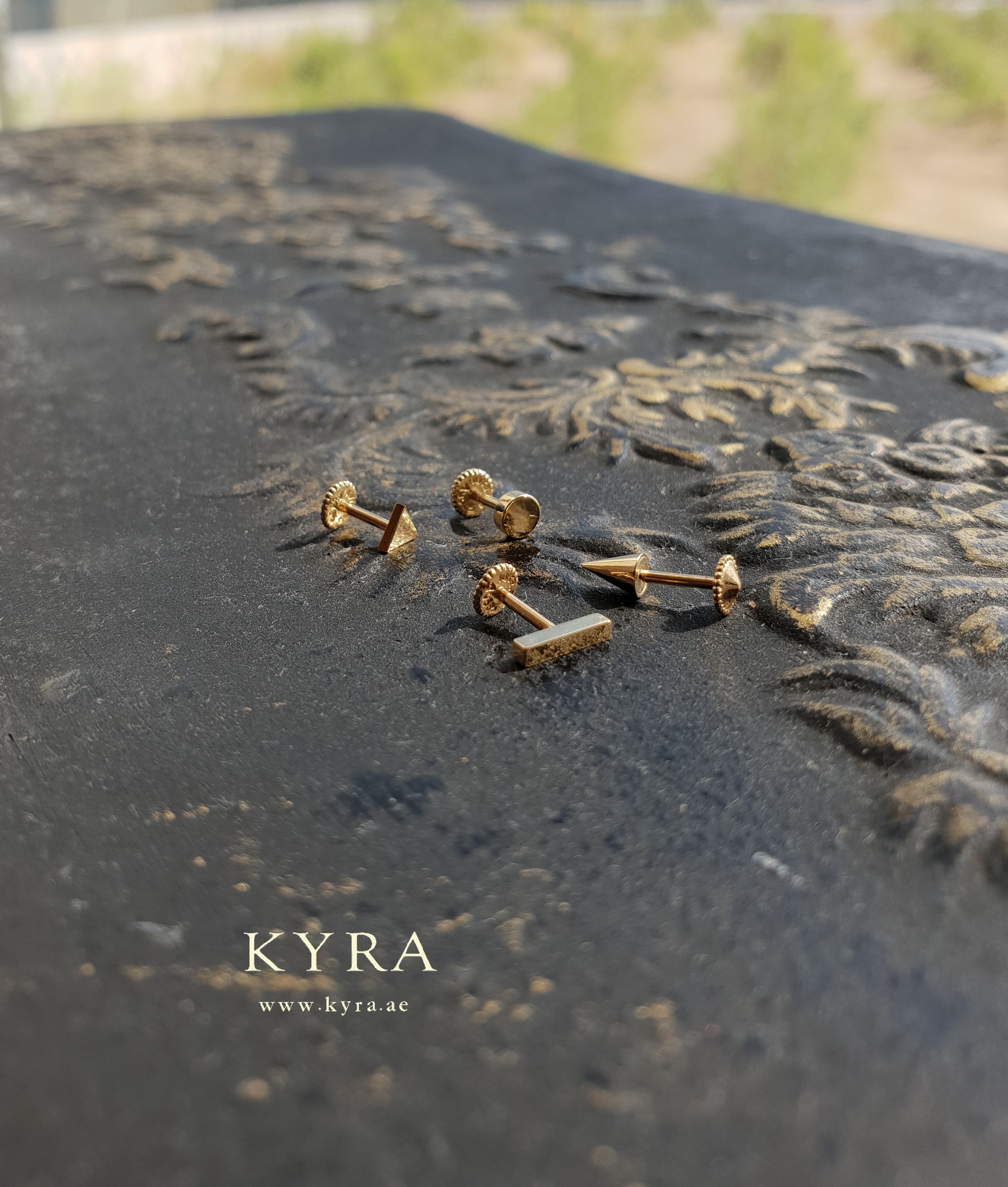
"Are Piercings allowed in UAE schools? The Complete Piercing Guide for Parents." - KYRA
Posted by KYRA on 10th Sep 2026

If you're a parent in the UAE, scrolling through stud earrings on the KYRA website that your child is keen on getting, while at the same time you are dreading if the teacher is going to ask her to remove them, you're not alone.
"Are piercings allowed in UAE schools?" is one of the questions our piercing team at KYRA gets asked most often for over 20 years now— usually right before the school year starts, and usually with a slightly panicked look on the parent's face.
Here's the short version, followed by everything else you need to know.
Quick Answer
Yes ! Piercings are Allowed. However, the exact rule always comes down to your child's own school handbook.
There is no single UAE federal law that bans piercings for students. Instead, the UAE's education regulators — the Ministry of Education (MOE) for public schools, the Knowledge and Human Development Authority (KHDA) in Dubai, and the Department of Education and Knowledge (ADEK) in Abu Dhabi — set broad standards for uniforms, grooming and appearance. Each individual school then writes its own dress code within those standards. In practice, this means:
- Small, single stud earrings in the earlobes are the piercing style most UAE schools permit, almost always for girls, and almost always required to be removed for PE or sport.
- Nose piercings, facial piercings, stretched lobes, and body piercings are NOT allowed in the overwhelming majority of UAE private and public schools.
- Boys in primary schools are typically not permitted to wear any visible piercing, regardless of curriculum (British, American, Indian, or others).
- Policies are set school-by-school, not emirate-wide, so the exact rule always comes down to your child's own school handbook.
Now let's unpack why that is, how the system actually works, and how to plan your child's piercing around it. Book a piercing appointment
How Piercing Rules Actually Work in UAE Schools
A lot of parents assume there's one national rulebook. There isn't. Instead, there are three layers:
1. The Regulator Sets the Principle, Not the Specifics
MOE, KHDA and ADEK all require schools to maintain a uniform and grooming policy that reflects discipline, safety and UAE cultural values. Public schools under MOE have moved toward stricter, standardised appearance rules in recent years — flat, fully closed black shoes only, sports shoes limited to PE, and an outright ban on nail polish and makeup, enforced through daily compliance checks. Piercings tend to fall under this same "discipline and simplicity" umbrella rather than being called out in isolated federal legislation.
2. Abu Dhabi (ADEK) Layers On Cultural Consideration Guidance
ADEK-regulated schools operate under a Cultural Consideration Policy, which several Abu Dhabi schools interpret to mean piercings — where allowed at all — should be minimal, discreet and modest, in keeping with local cultural norms. Some Abu Dhabi schools extend this further to staff as well as students, expecting even small facial piercings to stay covered or removed on campus.
3. The Individual School Writes the Actual Rulebook
This is the layer that matters most for your family. Two schools operating five minutes apart, under the same regulator, can have noticeably different piercing rules. What we consistently see across school handbooks:
- Girls allowed one small stud in each earlobe, no other piercings.
- Studs must come out for PE, swimming, and sometimes assemblies or formal events.
- Boys generally barred from any visible piercing.
- Nose piercings, cartilage piercings, and stretched ears explicitly listed as not permitted.
- Non-compliant jewellery is confiscated, with escalating consequences for repeat offences — warnings, letters home, detention, and in persistent cases, suspension.
Bottom line: Always check your specific school's parent handbook or uniform policy document.
What's Typically Allowed, By Piercing Type
| Piercing Type | Typical School Policy | Notes |
|---|---|---|
| Single earlobe stud (girls) | Allowed | Almost always must be removed for PE/swimming |
| Second or third earlobe piercing | Usually allowed | Many schools cap it at one stud per ear |
| Cartilage (helix, tragus, conch, rook, daith) | Not allowed for lower school or younger students | Falls under "no other piercings" clauses |
| Nose (nostril or septum) | Not allowed in most schools | Frequently named specifically in dress codes |
| Ear piercing (boys) | Refer to schools handbook | Some exceptions for jewellery of religious significance, with written approval |
| Eyebrow, lip, tongue | Not allowed | Treated as facial piercings; universally restricted |
| Navel, dermal, intimate piercings | Not applicable/not allowed | Not covered by uniform since not visible, but discouraged by school health guidance for minors |
| Jewellery of religious significance | Sometimes allowed, to be informed prior | Usually requires prior written approval from school leadership |
This table reflects the general pattern across KHDA- and ADEK-regulated private schools as well as MOE public schools. Your child's own handbook is always the final word.
Why Schools Require Studs to Come Out for PE.
This one isn't really about discipline — it's about safety, and it's worth taking seriously as a parent. Loose or dangling jewellery even hoops for that matter near the ear can catch on sports equipment, gym mats, swim caps, or another student during contact play, risking a torn earlobe or a snagged fresh piercing. This is exactly why, at both branches of KYRA, we generally recommend flat-back threaded studs for school-age children over traditional butterfly-back earrings: the flat, low-profile backing sits snugly against the ear, so it's far less likely to catch, snag, or dig in during PE, naps, or when a child sleeps on a hostel pillow during school trips.
Cultural Context: Ear Piercing in the UAE
Here's something worth understanding if you're new to the region: ear piercing for baby girls is a long-standing cultural and family tradition across the Middle East and South Asia, often done in infancy—long before a child ever sets foot in a UAE classroom. This is part of why most schools carve out an earlobe exception in the first place: by the time Emirati and many other regional families enroll their daughters in nursery or KG1, the piercing is already years old and simply part of daily life, not a new fashion choice made mid-term. It's also why the "no other piercings" rule exists—schools are drawing a clear line between a pre-existing cultural custom and a newer piercing trend picked up later in childhood or the teenage years.
Planning Your Child's Piercing Around the School Calendar
If your child wants (or is due, culturally) an ear piercing, timing it well saves everyone a headache. A few things our clients at KYRA plan around:
- Book during a school holiday, not term time. Summer break, winter break, or even a midterm week gives the piercing 3–6 weeks to settle before it has to survive a PE uniform check.
- Choose hypoallergenic, medical-grade jewellery from day one. A child can't easily explain skin irritation to a teacher, and a reaction mid-term can mean an unplanned trip to remove jewellery before healing is complete. At KYYRA we use materials like implant-grade titanium (ASTM F136 / G23) and solid 14K/18K gold specifically because they minimize the risk of contact dermatitis in sensitive, still-developing skin.
- Ask about the Inverness system for younger children. For infants and young children, senior piercers at KYRA recommend the Inverness system over a piercing gun or piercings done manually, precisely because it's gentler and better suited to the anatomy of a small ear. Read more in our piece on why KYRA chooses the Inverness system for baby ear piercing.
- Get it in writing if it's for religious reasons. If a piercing carries religious or cultural significance beyond a simple earlobe stud, most schools want a formal written request to the Head of Section before it's worn on campus—get that approval sorted before the first day back.
- Follow proper aftercare, especially in Dubai's heat and humidity. A school day means sweat, dust, and less time for a child to leave a fresh piercing alone. Our detailed guide on piercing aftercare in Dubai's climate covers exactly how to manage this.
Frequently Asked Questions
Is there a UAE federal law banning piercings in schools? No. There's no single nationwide law naming piercings specifically. MOE, KHDA and ADEK set general uniform, grooming, and cultural-consideration standards, and each school then writes its own detailed dress code within those guidelines—which is where the specific piercing rules actually live.
Can my daughter wear stud earrings in a Dubai private school? In most KHDA-regulated private schools, yes—typically one small stud per earlobe, often required to come out for PE and swimming. Always confirm against your specific school's handbook, since this varies school to school.
Can boys wear earrings at school in the UAE? At most UAE schools, no—visible piercings for boys are generally not part of the standard uniform policy, regardless of curriculum.
Are nose piercings allowed in UAE schools? Almost No in lower or primary school, subject to approval in secondary school years.
What happens if my child wears a piercing that isn't allowed? Policy is enforced school by school, but the typical escalation is jewellery confiscated or asked to be removed → email to parent from school leadership → It's rarely a first-offence suspension, but repeated non-compliance is taken seriously.
Can I get my daughter's ears pierced before she starts school? Yes, and it's actually the smartest time to do it. Piercing during a school holiday gives the earlobe time to heal before daily uniform checks and PE begin.
Does this apply to public (MOE) schools too, or just private schools? Both. Public schools under MOE have introduced increasingly standardized appearance rules in recent years, and while the emphasis is often on shoes, socks, hairstyles, makeup, and nail polish, piercings sit under the same broader grooming and discipline standards.
The KYRA takeaway
There's no single UAE-wide rule that says "no piercings at school"—but there's also no school where a child can turn up with a fresh septum piercing and expect it to be waved through. The real answer lives in your child's own school handbook, layered on top of general MOE, KHDA or ADEK grooming standards. For the one piercing style nearly every school does allow—the simple earlobe stud—the details matter: a gentle piercing method, hypoallergenic jewellery, and a flat-back design that survives PE, naps, and Dubai's climate without drama.
At KYRA, we've spent over two decades piercing ears for UAE families of every background, and we know exactly which studs, materials, and appointment timing will keep your child comfortable, compliant, and confident from day one of term. Book a piercing appointment or explore our medical-grade titanium and solid gold earring collections designed specifically for school-age ears.
This guide reflects general patterns observed across publicly available UAE school policies as of 2026 and is intended for informational purposes only. It is not legal advice. Always confirm current rules directly with your child's school and their respective school handbook.